Search This Blog

Showing posts with label DOE. Show all posts

Tuesday, January 31, 2012

Stormwater Visionary Tom Holz Has an Opinion on Proposed Regulations

Tom Holz is an engineer.
For decades he's been promoting the concept of "Zero Impact Design" to educate the stormwater community about the destructive impacts of stormwater runoff to our ecosystems and especially to Puget Sound. He was among a group called the "14 Scientists"  that crafted a letter to Department of Ecology, that ended up rocking their world. The group was sounding the alarm to that the Northwest ecosystem was crashing into serious decline, with salmon and other iconic wildlife listed as "Threatened Species" by the ESA.

Tom Holz is a Board Member for
People for Puget Sound
To make a long story short, that letter and Tom's testimony in a case brought by People for  Puget Sound and Earthjustice to the Pollution Control Hearings Board, ended up drastically changing the Stormwater Regulations for Cities.  In the Boards ruling in 2009, cities were required to implement "Low-Impact Development" techniques. PCHB’s so-called Phase II stormwater ruling
The Board concludes the (Washington Department of) Ecology must modify the permit to require permittees to identify barriers to the implementation of (low-impact development) and identify actions taken to remove those barriers, to establish goals for the future use of (low-impact development), and to require other specific actions on reasonable and flexible time frames, both during this permit cycle and in anticipation of future permits.
In other words, cities must clean up their acts!


Now Tom Holz is raising the alarm again. The Department of Ecology is again asking for comments on their latest round of regulations. People for Puget Sound is urging citizens to submit comments by Friday to DOE to

Stop polluted runoff and save our Sound

http://org2.democracyinaction.org/o/5430/p/dia/action/public/?action_KEY=9366

Tom Holz says they are still not getting it.

Will DOE PLEASE LISTEN? 

Washington State Department of Ecology Stormwater Management Manual for Western Washington, 2012 Update
Thomas W. Holz
The manual is based on deeply flawed assumptions.  Stormwater management depends on a computer program (WWHM) to impose a standard for development.  Although the program is derived from HSPF, a venerable and reasonably reliable stream flow simulation program, it was modified (originally by King County) to become a pond-sizing program for development projects.  The assumptions made in coding the pond-sizing program are unjustified, and the program is thus invalid for the purpose of serving as a test for acceptability of a development project. 
For example, it is assumed in the coding of ECY’s program, that a stream flow model (HSPF), which requires calibration to two years of stream flow to be valid, can somehow be converted to model runoff on discrete sites.  On such sites, stream flow data is non-existent and, more often than not, there is no stream to calibrate to.  The most egregious and invalid assumption buried in the WWHM model is that predevelopment overland flow is defined as the sum of predevelopment surface overland flow (near zero) plus groundwater flow.  This totally invalid assumption allows the developer to collect all precipitation on a site and route it as overland flow to the nearest stream (with catastrophic results on streams and aquatic life).
If WWHM is to continue to serve as the standard for development, it must be converted to a water balance model.  The water balance model would recognize the predevelopment fate of precipitation that falls on most discrete sites in a watershed:
1.    Evapotranspiration (ET) comprises about 18 inches per year (Beyerlein, 1999).  Maintenance of ET is critically important to a healthy watershed.
2.    Precipitation exceeding the volume evapotranspired is infiltrated (usually up to the 100-year storm event).
3.    Overland flow runoff in a typical watershed is less than 1% of stream flow.
Thus the water balance model would provide the developer with the tools to assess whether the practices employed on his project will maintain a water balance in close approximation to predevelopment water balance.  It is clear that, in this paradigm, evapotranspiration is the important parameter and its decline must be severely limited.
Without this change, and others that tend to reinforce low impact development practices, Puget Sound and its watersheds will continue on a path of steep decline.

Saturday, January 22, 2011

"King Tides" Initiative from Dept of Ecology

This weekend is scheduled to yield the highest tides of the year. Now is your chance to
submit images to Department of Ecology and participate in "citizen science".

Here is the DOE Flickr site - http://www.flickr.com/groups/1611274@N22/

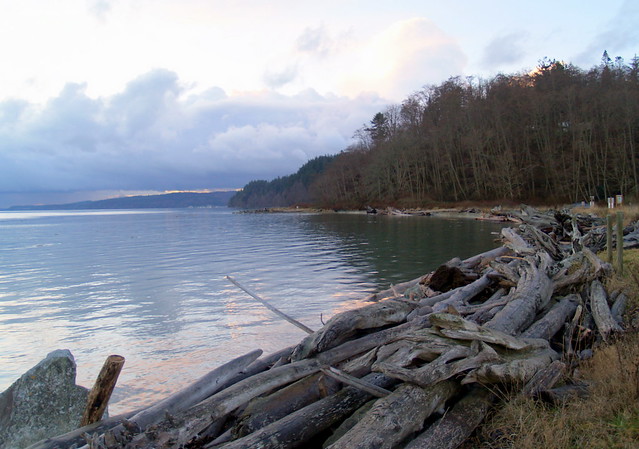
Take a walk on the beach at your favorite Puget Sound site and sharpen your eyes and lenses.
Then send in your photos. (Also Of Paramount Importance would welcome some good shots to show off!) DOE would like to record your impressions to better study the impacts of these highest tides.


photo
photo submitted to DOE site
by Cracklin Tulip

Ala Spit, Whidbey Island, Jan 8, 2011 8:30 am. High Tide 11.28


About Washington King Tide Photo Initiative

The Washington Department of Ecology invites you to participate in the January-February 2011 King Tide photo initiative. This is the second year for the initiative. Its objectives are to:

1) Identify and catalogue coastal areas currently vulnerable to tidal flooding (inundation); and
2) Gather compelling pictures, to engage the public and build awareness of the specific potential impacts of sea level rise and storm surge on the Washington coast.


King Tides are extreme high tide events that occur once or twice a year when the sun and moon’s gravitation forces reinforce one another at times of the year when the moon is closest to the earth. King Tide events offer a chance to visualize what future sea levels may look like. 

Coastal communities can monitor high tide and storm surge events to reduce potential damages and costs associated with these events in the future.Understanding the frequency and severity of high tide events, storm surges, and flooding is crucial in adapting to climate change. 

Sea level is predicted to rise up to 50 inches in Puget Sound over the next century. Significant parts of Washington’s coast are already vulnerable to impacts caused by high water levels and storm surges due to their close proximity to the shoreline or low elevation.

For more information on king tides and climate change, visit Ecology’s King Tide Website. Sea level rise projections for Washington State are published in the report, Sea Level Rise in the Coastal Waters of Washington State (Mote, Petersen, Reeder, Shipman, & Whitely Binder; 2008).

The Washington King Tide Photo Initiative is part of a West Coast partnership with the Ecology’s King Tide Website and other partners in California and Oregon. 

PARTICIPATE!
We invite you to submit photographs of coastal areas such as beaches, roads, parks and estuaries, known to be subject to flooding and erosion or areas where the high water levels can be gauged against familiar land marks, such as sea walls, jetties, bridges, dikes, buildings or other coastal structures. “Before and after” pictures showing average water levels and the extreme high water levels for the same location will also be useful.

1) Join this Flickr Group to view photos submitted from individuals around the state!
2) Take your own photos of king tides and add them to the flickr group!


King tide prediction information is available for certain communities in this table. If your community isn’t listed in the table, visit NOAA’s Tide Predictions website to find the dates, times and heights of tides in your area!

MORE QUESTIONS? 
Feel free to email us your King Tide Questions.

Contact Ecology

Tuesday, February 2, 2010

Heart of America Northwest Featured in CNN National News Report!


A recent CNN Report featured Hanford Expert and Activist, Gerry Pollett and his organization Heart of America NW. He points to concerns with how funds are being spent with Recovery Act dollars. Heart of America's message is "Clean It Up First".

The Hanford site is located in close proximity to the Colombia River and was the site which developed the components for the first atomic bombs and nuclear energy technologies.

Heart of America Northwest Featured in
CNN National News Report!

CNN national news report on Hanford features Heart of America Northwest and Gerry Pollet!!!

CNN news is running a special report on Hanford based on research we provided and featuring an interview alongside the Columbia River with me.

The story features really interesting footage of CNN's Patrick Oppman suiting up in protective gear to go inside Hanford 's massive and highly contaminated Plutonium Finishing Plant (PFP), which is being cleaned out and readied for demolition using stimulus funding.

Here is the link:


http://www.cnn.com/video/#/video/us/2010/01/27/oppmann.nuclear.stimulus.cnn?iref=allsearch

This would never have happened without Heart of America Northwest's organizing and legal work. In the 1990's, USDOE wanted to restart processing of Plutonium for weapons at PFP. We forced shutdown of the plant - which dumped its untreated liquid wastes straight into soil ditches - with a lawsuit and two straight years of organizing turnout to hearings (with Washington State, at the time, actually opposing our efforts).

CNN is posting additional interview footage with me and other background on its website.

This coverage is a wonderful start for our push to generate news coverage of USDOE's plans to use Hanford as a national radioactive waste dump and NOT to cleanup the High-Level Nuclear Waste leaked from Single Shell Tanks for the hearings on USDOE's "Tank Closure and Waste ManagementEIS" running through March 8th.

USDOE's own analysis shows that its plans will cause the Plutonium level entering the Columbia River to increase to 300 times the Drinking WaterStandard over the next thousand years!!! That equates to an adult fatal cancer risk of 3% for any adult drinking that water... and children are 3 to 10 times more susceptible to cancer from the same dose than an adult.

The cancer risk from drinking groundwater will be ten times worse if USDOE gets to import and bury 3 million cubic feet of radioactive waste! This is USDOE's own analysis buried in the 6,000 page EIS.

Hanford is the single largest recipient of stimulus funding in the nation, with $2 billion. We are concerned that USDOE is not using any stimulus funds to get waste out of the leaky Single Shell High-Level Nuclear Waste tanks faster; despite this being the USDOE's proclaimed top priority for safety and the environment. The day Patrick Oppman joined me out at Hanford, USDOE responded to my analysis that they were inflating their claim of jobs created with stimulus funding by announcing a 50% reduction in the number of jobs USDOE claimed have been created at Hanford with stimulus funds.

Please plan to join me at the hearing nearest you to add your comments opposing USDOE's plans to use Hanford as a national radioactive waste dump. All hearings begin at 7 PM, and we will hold pre-hearing workshops at 6PM: Feb. 9 Hood River BW Hotel; Feb 10 Portland Doubletree Lloyd Center ; Feb. 22LaGrande OR; Feb. 23 Spokane Red Lion at the Park: March 1 Eugene, OR Hilton; March 8th Seattle Center Northwest Rooms.

We are also holding pre-hearing workshops in Portland on Monday, Feb 1st (at Whole Foods, Fremont at 7:30 PM) and with Hanford Challenge in Seattle on Saturday March 6th in the morning at 10:30 AM (Hugo House). We'll be at Spokane Community College on Feb. 17th, and at the Eugene U of O Public Interest Environmental Law Conference on Feb. 27th.

This is an intense organizing effort for we are trying to raise the $10,000 needed to mail our four page Citizens' Guide to 20,000 households and support our travel and organizing for the workshops and hearings. Please consider making a tax deductible contribution on-line (secure at www.hoanw.org) or by mail ( 1314 NE 56th St. #100 ) to help us raise the funds needed to print and mail the Citizen's Guides on time.

As always, please call me if you have questions or suggestions. I hope to see you at one of our workshops and hearing.


Gerry

Gerry Pollet, J.D.;

Executive Director,

Heart of America Northwest

"The Public's Voice for Hanford Clean-Up"

(206)382-1014

gerry@hoanw.org

Sunday, January 31, 2010

Steven Chu Announces $1.4 Billion Loan to Nissan for LEAF Electric Car

Celebrating our "ONE MONTH ANNIVERSARY" for "Of Paramount Importance" Blog all day today! We'll feature stories from various areas of the environmental spectrum.

Thanks to all of our "Followers" "Commenters" and everyone who's checked in on our new adventure. Look forward to your future participation, tips and ideas as our local blog evolves.
It here for all of you to use to share information, issues, good news and challenges.

Best Wishes in February 2010 - Janet Way

Here is more good news for the environment from Treehugger Environmental Blog.

Steven Chu Announces $1.4 Billion Loan to Nissan for LEAF Electric Car

by Michael Graham Richard, Ottawa, Canada on 01.29.10

nissan leaf steven chu photo
Photos: Nissan, DOE

About 1,300 New Jobs at Smyrna Factory
Steven Chu announced that the U.S. Department of Energy agreed to loan $1.4 billion to Nissan for the modification of their Smyrna plant in Tennessee. This will help Nissan start production of the LEAF electric car (coming to
British Columbia in 2011 and the rest of the world in 2012) and build an advanced battery manufacturing facility.

nissan leaf photo
Photos: Nissan

Dr. Chu said: "This is an investment in our clean energy future. It will bring the United States closer to reducing our dependence on foreign oil and help lower carbon pollution. We are committed to making strides to revitalize the American auto industry and supporting the development of clean energy vehicles."

Nissan's goal is to make about 150,000 LEAFs and 200,000 battery packs a year in Smyrna once production is up to speed. This should create about 1,300 jobs.

In September 2009, Ford received a $5.9 billion loan, and just last week Tesla's $465 million loan with the DOE was finalized.

It's Finally Starting to Happen
Getting electric cars to market is taking longer than a lot of people would like, but manufacturing on this scale is long and expensive. It seems like a couple years ago, everybody was coming up with electric concept cars but almost nobody was actually taking actions to commercialize them. Now we seem to be entering a new phase: Companies are working hard to find financing, build/retool factories, make partnerships with battery companies or bring that expertise in-house, etc. Certainly a step in the right direction, though widespread adoption of EV will still depend a lot on oil prices in the next 5-10 years, and on battery technology improvements.

Once again, a carbon tax (revenue neutral would be best) would help make this happen much faster. As long as people don't pay directly for the cost of air pollution and global warming, the playing field won't be level with clean(er) technologies.

Via DOE

More Nissan LEAF Electric Car
Nissan Working on New Battery to Double the Leaf's Range by 2015
Nissan LEAF: Instead of Engine Choices, People Might Have Battery Choices
Nissan LEAF Electric Car to Come to British Columbia First (in 2011)