Search This Blog

Showing posts with label Friends of Aldercrest. Show all posts

Tuesday, January 11, 2011

Aldercrest "Park" Good News!

Friends of Aldercrest has great news about their project to create a new community park. The old Aldercrest School site was previously considered as a a nominee by Shoreline for the jail proposal. There were six sites considered in that process by north King County cities. 

But the "new jail" proposal was soundly rejected by this community and many others. A new solution was found for jail space by King County and City leaders last year.


The Aldercrest Community used this situation to advocate for a much needed community park. They have been meeting in a process with Shoreline and School District staff and are announcing a break through!

The organization has a website that can be checked for additional information.
http://friendsofaldercrest.org/

Congratulations to the Friends of Aldercrest for an outstanding effort and great outcome for our entire community!

We are happy and proud to announce that an agreement has been reached to ensure a permanent city park at Aldercrest Annex! Through the collaboration and hard work of the Shoreline School District, City of Shoreline, Ballinger Neighborhood Association and the Friends of Aldercrest, we have crafted an agreement that is a true win-win-win for the District, City and our neighborhood.  Once the 16-acre site is sold by the School District to a new owner, a 6 to 7-acre park will be dedicated to the City while the remainder will be developed under one of three scenarios (see more about the details below and on our website). We want to thank not only the District and City, but most of all our partners at Ballinger Neighborhood Association and the many neighbors and friends who have supported our efforts to save our park!
What happens next?
To provide an opportunity for interested community members to learn more about the agreement, the Friends of Aldercrest and Ballinger Neighborhood Association will hold a community meeting on Thursday, January 27 from 6:30-8:00 PM at Living Wisdom School in the Aldercrest Learning Center (north side of NE 200th St directly across from Aldercrest. City staff and Superintendent Sue Walker will also be available to answer your questions.  
Next, the agreement must be approved by the City of Shoreline through an open and public process. The City’s Planning Commission will hold a single public hearing on the two parts of the agreement:
1.     Proposed new language for the City’s Comprehensive Plan 
2.     Proposed zoning provisions to govern future development and the dedication of park space.
The public will have an opportunity to weigh in, so please make it a priority to come to the hearing and speak on behalf of the agreement.  The tentative date for the hearing is Thursday, February 17 at 7:00 PM at Shoreline City Hall.
What can YOU do?
·       Attend the community meeting to learn more about the process and the agreement.
·       Write letters of support to the Planning Commission prior to the hearing. The Commission reviews all correspondence received prior to the hearing, but please do not wait until the last minute. Send your e-mail comments to plancom@shorelinewa.gov
·       Attend the public hearing and give testimony in support of the agreement.
·       Tell your neighbors about the agreement and encourage all of them to help us push this across the finish line!

For more information, see  www.FriendsOfAldercrest.org

Wednesday, October 6, 2010

Dilapidated Building at Aldercrest Annex Is Torn Down

From Nancy Morerya of Friends of Aldercrest

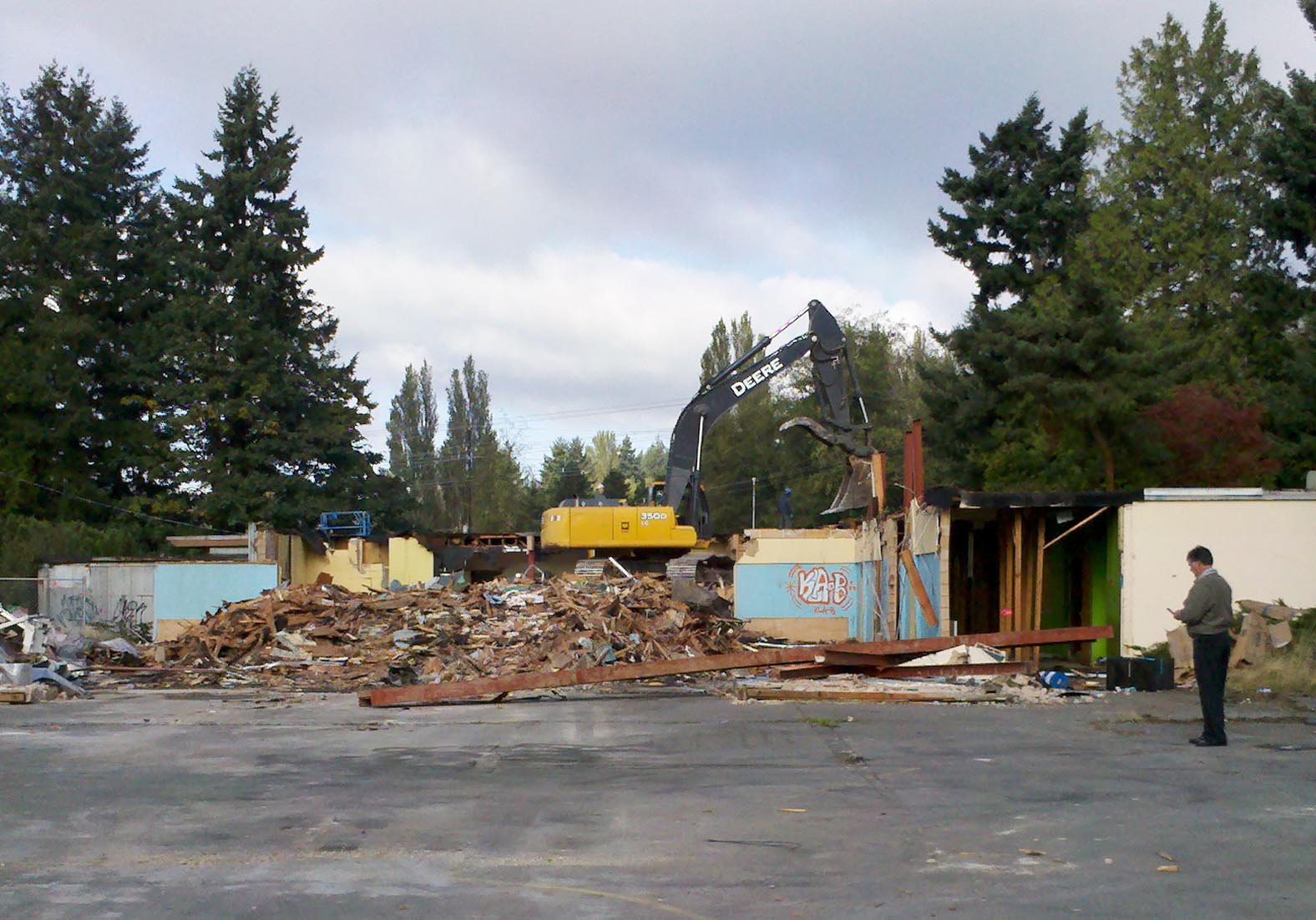
  On October 4 & 5, the demolition crew began tearing down the Old Kellogg Middle School cafeteria building at Aldercrest Annex (see picture below).  I am not sorry to see the dilapidated building come down because it has been an eyesore for years and has attracted illicit activities.  However, the history of the building is interesting (refer to “Shore to Shore, Line to Line: A History of the Shoreline School District”)

Aldercrest Middle School now a pile of rubble
photo credit-Nancy Moreyra

Einar Anderson of Steinhart, Theriault, & Anderson Architectural firm of Seattle designed the building, a firm that designed many of the schools in the 1950’s and 1960’s across King County.  The school facility was completed in 1962 for a project cost of about $1.1 million (that’s roughly $13.00 a square foot).  Because of the era in which it was designed, the building has some “Googie” architecturedetails (e.g. the scalloped roof-line on the class room buildings that can be seen over the top of the old gymnasium).   

    The Shoreline school District named the new school after Nobel prize winner, Frank Billings Kellogg.  At that time, the District named its middle schools after Nobel prize winners (e.g. Einstein, Thomas Hunt Morgan, and Nicholas Murray Butler).  The school was dedicated November 1962 with Francis Thieman as the first principal. Only a few years after its opening, over 700 students attended class which housed 7, 8, and 9th graders.  With over 700 students and full staff of teachers and administrative personnel, the school was a bustling and busy center of learning!

    In December 1982, arson destroyed the school’s library and activity center.  (The open slab of concrete that can be seen in the fore-front of the picture is near where the library once stood.)  Old Kellogg was closed in 1986 and the school moved to the Thomas Hunt Morgan Middle School which was remodeled and renamed Kellogg Middle School.

    To me, this week’s demolition and the current work of the Aldercrest Annex task force mark a new beginning for the old school property.  It once held an institution of learning and hopefully the future will bring another community-enriching use for the land – the core objective of the task force.

Monday, June 7, 2010

Everett Herald Story - Tulalip Tribe Restores Wildlife Habitat

Fascinating story from Everett Herald by Gale Fiege yesterday on how the Tulalip Tribe has created intentional habitat areas, that begin as meadows at Camano Head.  Deer, elk, and many other mammals and species have flocked to these areas. This technique follows age old tribal customs.

Could other communities try this method on smaller scale? This type of accidental habitat creation happens when development projects are abandoned or changed. Other uses, such as community gardens, or educational uses can benefit. Of course we're not suggesting that elk will migrate to the urban areas, but on a small scale this concept CAN bring wildlife diversity to our communities.
Why not make the best of these opportunities? 

photo credit/FOA
Tonite Shoreline City Council will be discussing the Aldercrest  

photo credit/save cedarbrook
and Cedarbrook 
park proposals and what possibilities are available to protect these areas for public use. Habitat and Open Space is one very good potential usage for these large "surplussed" school sites.


Published: Sunday, June 6, 2010
TULALIP — High on this bluff, Tulalip Tribes member Gary Baker enjoys the view across the lush meadow, over the water and out to Camano Head.


Photo Credit -
Dan Bates / The Herald  (click to enlarge)Mike Sevigny walks through the dense meadow on the Tulalip Indian Reservation on May 11. Sevigny was surprised by the amount of reseeding that took place naturally since the meadow was first planted.


Generations ago, Coast Salish people set small wildfires to create meadows like this for hunting and gathering.

Baker, 63, used a backhoe in 2008 to carve out this one.

He remembers removing Scotch broom, Himalayan blackberry and old tires that littered the area. He tore down scrubby trees, salvaged firewood for tribal elders and prepared the soil for planting.

The Bluff Meadow is one of four that the Tulalip Tribes have created among the reservation's 8,000 acres of forest. The Bluff, Upper, Middle and Lower areas combine for about 12 acres of meadowland forage for wildlife.

Tulalip and other local tribes also are part of efforts by the state and a national elk hunters group to improve and maintain several forage meadows in the North Cascades foothills.

“It makes me feel good when I see it now,” Baker said of the Bluff Meadow. “It's beautiful here, and it's gonna work.”

What's working is a growing deer population attracted to the

meadows on the Tulalip reservation. Motion-activated cameras at each of the meadows record the numbers and mark the progress.

First there was a single deer. Then a group of bucks. Today, the camera in the Bluff Meadow is recording the return of young does and their babies, said Mike Sevigny, wildlife manager for the Tulalip Tribes.

“They eat day and night. We don't see skinny animals anymore. The females are healthier and they have healthier young,” Sevigny said.

And this means a healthier population for the tribes to hunt, he said.


  • Creating meadows for wildlife is not a new concept and not one that benefits only Indian tribes.

    The Tulalip, Stillaguamish and Sauk-Suiattle tribes have joined other Point Elliott Treaty tribes to help the state Department of Fish and Wildlife and the Rocky Mountain Elk Foundation revitalize and maintain three elk meadows in eastern Skagit and Whatcom counties.

    That effort has helped the once-endangered Nooksack elk herd grow to numbers that allow tribal and state-licensed hunters more opportunities to harvest the elk. Last year, the herd had an adequate bull-to-cow ratio to allow for a limited hunt of 50 bull elk: 25 for the nine Point Elliott Treaty tribes and 25 for state-licensed hunters.

    The meadows also are designed to encourage the elk herd to remain in the foothills. The idea is that the tasty, nutritious meadow plants will draw the animals out of agricultural areas and away from roads, housing developments and timber plantations.

    “Elk can do a lot of damage to young trees, farmland and cars, and nobody wants that,” Sevigny said. “The real test of these meadows will be: Do the animals show up and stick around?”

    Elk, called 
    kwah-gwee-chud in the Lushootseed language, are as important to tribal songs and stories as the salmon, Stillaguamish Tribal leader Shawn Yanity said.

    “The meat is irreplaceable for our health,” Yanity said. “And the meadows are another way to support and enhance a resource that's important to our culture.”

    Yanity also praised the meadow project in the foothills as a way for Rocky Mountain Elk Foundation members, state Fish and Wildlife officials and sister tribes to work together.

    “Maintaining the Nooksack herd is nice common ground for all of us,” Yanity said.


  • In the 1990s, Indians and non-Indian hunters stopped hunting Nooksack elk when it was estimated that the herd that once numbered 1,700 had declined to about 300 animals.

    Lenny Thompson, a Mount Vernon hunter, got involved with the national Rocky Mountain Elk Foundation about 10 years ago.

    “Our first priority is wildlife enhancement, and the tribes have really stepped up and done a lot of work,” Thompson said. “The demise of the herd was due in part to the easy access to the elk. I'd like to see the closure of more logging roads so people have to hike in to hunt.”

    Easy access was part of the problem in December when a special archery-only elk season went awry west of Concrete, he said.

    A band of elk were shot after congregating in a fenced pasture along busy Highway 20. Lots of people saw the hunt, which upset experienced hunters and animal-rights people alike.

    Though the hunt was legal, “what happened was unethical,” Thompson said. “Our forage meadows should help feed the elk and keep them away from the highway.”

    Thompson praises Sevigny and the Tulalip meadow team for their work on behalf of the Nooksack elk herd, as does Fish and Wildlife game division manager Dave Ware.

    Those involved in the meadows program meet regularly and are in the process of updating the five-year plan for the elk herd, Ware said.

    “Whether a forage meadow is on public, timber or tribal land, it's a good thing that benefits everyone,” Ware said. “And the Tulalip meadows sound like perfect forage areas.”


  • The forest on the Tulalip reservation is dense with 30-year-old Douglas fir trees.

    Herbicides previously sprayed on former clear-cut areas kept natural vegetation from returning. After a few decades, the trees created a canopy, blocking out sunlight to plants on the forest floor. In some areas on the reservation, only hardy blackberry vines and other invasive, non-native plants took hold.

    It wasn't a pretty sight, Sevigny said.

    The decline of wildlife forage areas forced deer to look elsewhere for food and onto farmland and into people's gardens and landscaped yards.

    “The fact is deer do not want to eat your garden,” he said. “They would much rather be safe.”

    Since 2006, the Tulalip Tribes have spent about $100,000 for staff time and materials for the meadows program. Eventually, Sevigny would like to see 60 to 100 acres of meadows on the reservation.

    “When the meadows start looking like a golf course, we'll know we've maxed out on the number of animals that these areas can support,” he said.

    Last year, Sevigny and his crew decided to continue their reservation meadow project with the planting of what they call the Middle Meadow.

    They staked out a two-acre spot where trees were dying from root rot. Baker brought in the backhoe to push out the dying trees. Before the first frost in October, the team hydro-seeded a mix of three types of clover, chicory, small burnet and rye, along with mulch, lime and fertilizer. The plants are known for their high-quality nutrients, Sevigny said.

    By the first of May, the meadow grass was tall enough to provide deer some good escape cover and nice areas for bedding down.

    “It blew me away last month,” Sevigny said. “We've been very pleased. Any farmer would be jealous of the number of bees we have in the new meadow.”

    Along with the deer, birds, frogs, porcupine, rabbit, raccoon, coyote and cougar have been seen in the meadows.

    “It's an amazing amount of wildlife.”


  • It began simply as a way to enhance wildlife numbers.

    Then Sevigny remembers the day he realized that the forage meadows, especially the bluff that overlooks Possession Sound, were not just there to encourage the growth of a deer herd for hunting.

    People like to walk their dogs on the bluff or take their kids out for hikes,” he said.

    “There's even a marked grave for somebody's dog on one side of the meadow,” Sevigny said, pointing.

    Nearby, tribal member Charlie Cortez, 18, searched for a four-leaf clover. Cortez has been part of Sevigny's meadow crew for several years. He's proud of the work they have done.

    In the future, they would like to bring back native plants such as Nootka rose, huckleberry and native clover for teas. They also want to encourage the growth of the little trailing blackberry that tribal elders love to pick in the summer.

    Cortez smiled as he showed off a fistful of four-leaf clover stems. His boss nodded in appreciation.

    Sevigny also remembers the day Darrell Enick, a tribal elder and fish and wildlife enforcement officer, told a story about the Bluff Meadow.

    Enick wanted to take his nephew up to the mountains, but he couldn't make the time for the drive. Instead, he told Sevigny, he took the boy up to the bluff for a hike to show him traditional uses for plants and teach him how to get back home if he ever got lost in the woods.

    The meadow is a wonderful place for the people of Tulalip to enjoy, Sevigny said.

    “So I learned that what's good for the tribe is what's good for wildlife,” he said. “It's been that way from the beginning.”
    Gale Fiege: 425-339-3427, gfiege@heraldnet.com.


  • Sunday, May 23, 2010

    Shoreline Community Garden Grand Opening Saturday

    A wonderful article about Seattle Tilth and Good Shephard Center on the Tree Hugger blog today (below). 
    The Community Gardening movement is catching fire in our area too.
    Shoreline now has a brand new Community Garden, which held its grand opening celebration Saturday.

    The Ballinger Neighborhood Association and the Shoreline Community Garden Group teamed up on an exciting project this season.
     

    Community Garden Group Mission Statement:
    Foster the creation of a sustainable food system, environment, and community, by networking, educating, building community gardens, and sharing resources.
     

    There are 18 Community raised bed, garden plots, 2 food bank plots, educational kiosk,  water source and tools. The effort is an entirely volunteer project and it provides beds to people in the immediate neighborhood. Many of them live in nearby apartments or condos and have no yards, so this project provides them with the space and means to grow their own food.
     Community Garden Raised Bed at Work!
    Photo credit - Linda Stein


    Rep Maralyn Chase enjoys the celebration with volunteers
    photo credit - Corey Murata


    There is room to expand, and lot's of features are being added such as decorative plantings to make the location look nice year round.

    The groups goal is to expand the project throughout the City.

    Volunteer Jan Stewart said, "It looks pretty darned good! It's an example of taking a desperate patch of earth, overrun with invasive weeds, a terrible, forgotten piece of ground. And the group of dedicated people, including Joyce Lingerfelt, Londa Jacques, Judy Griesel, Linda Stein and others, came together and said, "Let's do it".  Brian and Meghan Peterka and their family really pitched in and made it work. It's a lovely example of how to do a grassroots project."

    Before


    In Progress


    Rain City Rotary provided a lot of the community backing and the Ballinger Neighborhood Association
    received  a Shoreline Neighborhood Mini-Grant, which provided supplies. Also, of course the Shoreline School District allowed the community to use this piece of land behind Aldercrest Learning Center.

    Brian and Meghan Peterka and their two children have a folk music combo which provided entertainment.

    photo credit - Linda Stein
    Peterka Family Band


    Our group meets:
    The Shoreline Community Gardening Group meets on the 4th Tuesday of the month, at City Hall, in Room 301, from 6:30-9pm.  All are welcome!


    _____________________________________________________________________
    http://www.treehugger.com/files/2009/08/urban-farmers-and-repurposed-building.php


    Tree Hugger 

    Urban Farmers and Repurposed Building for Nonprofit Tenants

    by Roberta Cruger, Los Angeles  on 08.23.09
    chicken coop photo


    Tenants of urban chicken farming. Photo by Steven Walling via Flickr
    Sometimes I miss living in Seattle. I used to teach at a converted building dedicated to nonprofit orgs and low-income artist housing. There are similar endeavors in many cities, but in Seattle it’s everywhere and at the Good Shepherd Center, located a mile away from my former home, one of the tenants, Seattle Tilth, inspires and educates people to garden organically and consider urban chicken coops and beehives. My neighbors upstairs turned half our yard into a garden. Last week it held a workshop in Herbal Tea Gardening and on the 23rd it gives one on Composting for Apartment Dwellers. Take a look at the tenants inside this one building. Shouldn’t every city have one?
    Good Shepherd Center photo


    Former Good Shepherd School turned home for nonprofits with organic garden in Seattle. Photo by JWalsh via Flickr
    Good Shepherd Center tenants include a local holistic center and all of the following:
    Cascade Harvest Coalition: builds a sustainable local food system by supporting farmers and consumers. Programs and activities address the local food and farm system, promotes preservation and protection of farmlands and resources, improves access to locally-produced food. Works with Puget Sound Fresh www.pugetsoundfresh.org consumer education program; Farm to Table, Washington FarmLink providing farmer education services, and others.
    International Snow Leopard Trust: works to conserve the endangered snow leopard and the biological diversity of the snow leopard's wilderness habitat in central Asia through balanced approaches that consider needs of people and the environment. ISLT supports programs of research, monitoring, field conservation, training, technical assistance, and environmental education.
    Washington Toxics Coalition: protects human health and the environment by preventing pollution. It advocates pollution-prevention based policies, supports sustainable and organic agriculture, promotes alternatives to pesticides and other toxic products. Works with farmers, farm workers, and local citizens concerned with securing a safe environment.
    Washington Water Trails Association: works to build partnerships with public and private organizations to manage water trails, instills a strong stewardship ethic for the aquatic environment, and encourages the use of "blueways." The Cascadia Marine Trail provides resting sites for small hand-carried human-and wind-powered watercraft users on Puget Sound from Olympia to the Canadian border, and the Lakes-To-Lakes Water Trail.
    Seattle Tilth: volunteer organization of gardeners interested in environmentally sound ways of growing edible and ornamental plants. It also administers the city's Community Compost Education Program. Committed to increasing urban self-reliance by sharing ideas and techniques in organic gardening, edible landscaping, composting and related subjects through its newsletter, demonstration garden and children’s garden, workshops, lectures, tours, and referrals.


    Seattle Tilth sign photo
    Photo by JWalsh via Flickr
    Upcoming classes to assist the urban farmer include “Fall and Winter Container Herb Gardening” and "City Chicken 101” an intro to chicken husbandry in urban and suburban settings, and “Lawns to Lettuce” workshop. Seattle Tilth's Harvest Fair happens Saturday, September 12.


    Seattle has become known as a world-class chicken destination and Seattle Tilth offers an annual Chicken Coop tour with resident chicken keepers. Also tours urban dwellers with goats, ducks and bees with a self-guided map through neighborhoods. Considered a "weird eco-habit” in Treehugger in 2005, is it still?
    More on chicken coops and home gardens: 
    The Stealth Chicken Coop - Keeping Swine Flu and Zoning Officers
    Another Kind of Chicken Coop
    Sowing the Seeds of Sustainability: Victory Gardens are Back
    18 Beautiful Edible Landscaping Plants

    Wednesday, May 19, 2010

    Jail Sign Torn Down!

    We see this as definite "Progress"!
    Best of luck to the Ballinger Neighborhood on a new Park Plan!


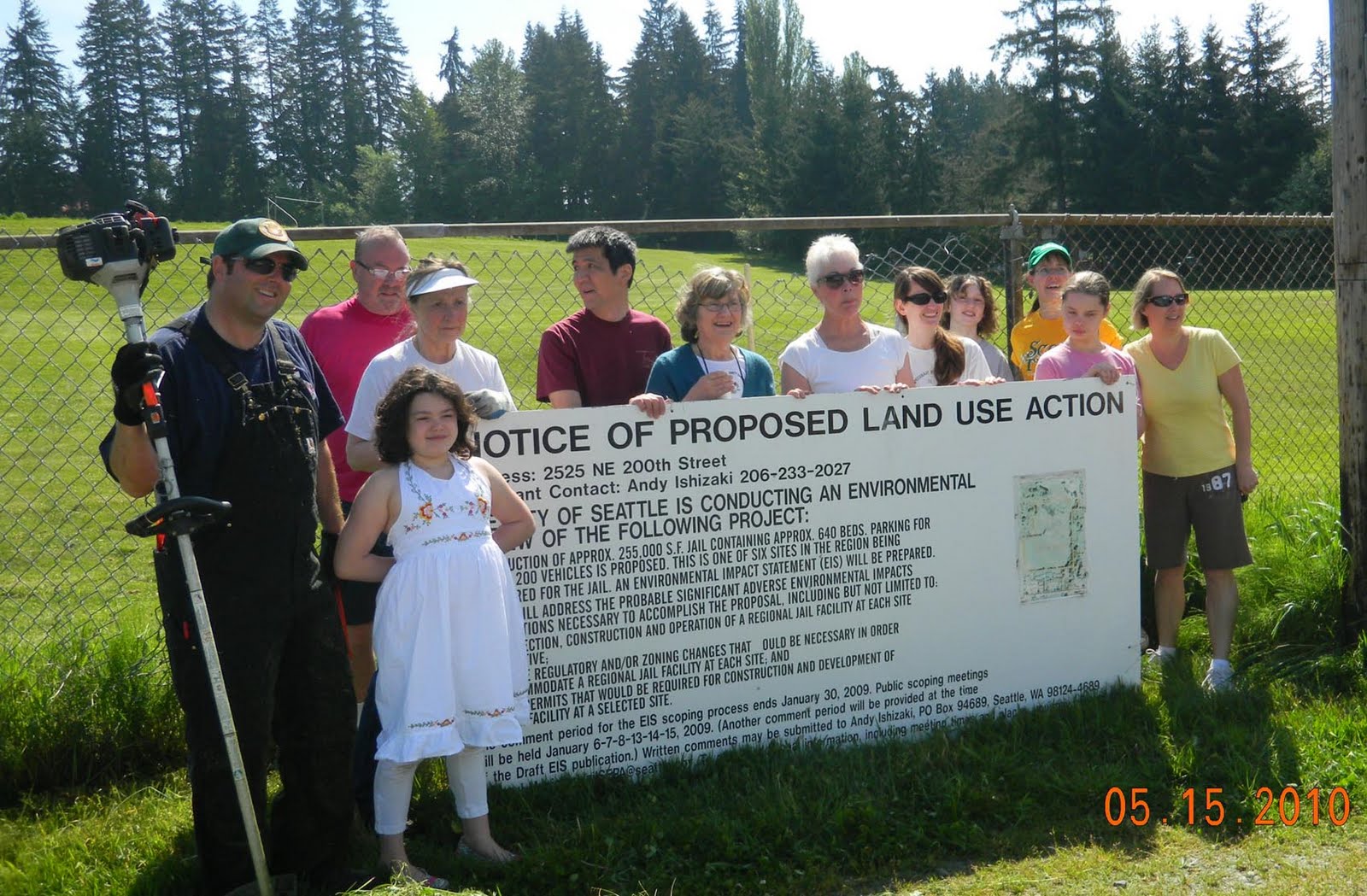
    The Ballinger Neighborhood tore down the Jail Project “Proposed Land Use Action” sign at the Aldercrest Annex cleanup on Saturday, May 15, 2010.

    We were anxious to bring the jail sign down because it represented 18 months of opposing the jail project that threatened to take away our community park.  Now that its gone, we can focus on developing a city park out of the old Kellogg middle school.  We are pushing the City of Shoreline to work with the Shoreline School District and come up with a plan to acquire the property as a city community park.

    The organization that held the Aldercrest Annex cleanup was the Ballinger Neighborhood Association.  The chair of the Association is Joyce Lingerfelt 
    (shown in the center of the photos)


    The City of Shoreline is now willing to talk about Aldercrest Annex as something other than a Jail.  Aldercrest Annex will be a discussion point (among a few other topics) at the Ballinger Neighborhood meeting on May 25, 7pm, at Aldercrest Learning Center.  In addition, Aldercrest Annex will be discussed along side of Cedarbrook at the Shoreline City Council Special Study Session on June 7.

    Keep pressing forward ....

    Nancy Moreyra
    Home in Shoreline
    Co-Chair Friends Of Aldercrest

    Thursday, May 13, 2010

    Breaking News - No Jail in Shoreline: NEC Jail Siting Process Comes to an End

    Friends of Aldercrest Co-chair Janne Kaje has made a statement after the announcement by KC Executive Dow Constantine about the "Jail" issue.

    "Our neighborhood, which includes residents of Shoreline, Lake Forest Park and Mountlake Terrace, is obviously very relieved after more than a year and a half of hard work, angst and waiting.  With the black cloud gone we hope that residents, the School District and the City will come together in earnest to ensure that all or most of this public land stays in public hands as park space. It may take some time to rebuild trust between the city and the neighborhood, but I am hopeful knowing that steps toward doing so are already being taken. For those residents who want to get involved, we hope they'll join the Friends of Aldercrest in working toward a positive, community driven future for the site, and also support the broader neighborhood vitalization efforts of our partners in the Ballinger Neighborhood Association."  

    Shoreline's Ballinger Neighborhood had been one of the six sites that were being reviewed as potential locations for a Regional Jail.


    Shoreline has also made and announcement confirming that this long nightmare is over for the Ballinger neighborhood.


    Posted Date:5/13/2010 9:30 AM
    Shoreline’s Ballinger neighborhood – as well as the rest of the City – can let out a 
    sigh of relief as the NEC jail siting process comes to an end.  Today King County 
    Executive Dow Constantine announced that King County is offering jail beds to 
    cities through 2020 and plans to form a regional jail planning group.  Due to the 
    county’s proposal in concert with new options for contracting jail beds regionally, 
    Seattle Mayor Mike McGinn has recommended ending the process of siting a new 
    regional municipal jail.

    “King County’s offer for a regional solution and additional beds through 2020 
    provides our City the confidence to sunset the environmental impact review 
    process,” said Shoreline Mayor Keith McGlashan. “That is truly good news for 
    our community, particularly for our residents in the Ballinger neighborhood 
    now that Shoreline no longer has a site under consideration for a jail.”

    Cities in King County originally formed regional groups to address the projected 
    loss of jail bed space after King County’s bed space projections determined there 
    would not be available jail beds for cities after 2012. The north and east cities 
    including Shoreline and Seattle formed the NEC and the southern County cities 
    formed the South Correctional Entity (SCORE). SCORE is building a jail, now under 
    construction in Des Moines and expected to open in 2011, which will have jail beds 
    available for rent to King County cities through 2020.

    With the available beds from King County and SCORE, and with the other 
    municipal jail beds available in the region, the NEC believes there will be enough 
    capacity to cover all of its misdemeanant jail bed needs through 2020 without 
    having to build additional capacity. 

    As a result of these projections, Seattle has recommended and Shoreline and the 
    rest of the NEC cities concur, stopping the current environmental impact review 
    process being conducted on the six potential sites for a regional municipal jail for 
    north and east cities. Stopping the process will remove the Shoreline site, along 
    with the other sites, from further consideration as a possible location for the 
    construction of a regional municipal jail. 

    For more information, contact City Manager’s Office Management Analyst 
    Eric Bratton at (206) 801-2217,ebratton@shorelinewa.gov.
    « Back

    Saturday, May 8, 2010

    Exciting News about Aldercrest Jail Site and Proposal for Park

    This announcement is the outcome of and represents a great deal of work by grassroots organizers in the Ballinger Neighborhood and Lake Forest Park.

    Nancy Morerya is chair of Friends of Aldercrest which is continuing its advocacy for a permanent park on the Aldercrest site, because of the genuine need for more Parks and Open Space in this neighborhood and the entire Shoreline Area. The site contains enormous potential for recreation, wildlife habitat and passive uses. It is located in the Lyon Creek Watershed, which needs a lot of mitigation to reduce downstream flooding.


    After the May 13 news conference and Aldercrest Annex is officially released from
    the Jail Project, the work towards getting a city park developed at Aldercrest Annex
    becomes most crucial.  Involvement from all of us is very important!  So please
    stay with us because we are not yet done.

    I understand the news conference on May 13 will take place at the County Executive
    Conference/Media room in the Chinook Building downtown Seattle at 9am to 10am.
    The Mayor of Shoreline will be there participating.

    Nancy Moreyra
    Home in Shoreline, WA


    -----------------
    CONGRATULATIONS! No official announcement has been made, but NoShorelineJail
    has learned that on May 13 there will be a news conference hosted by County
    Executive Dow Constantine to announce that the planning for a new north-end
    jail has been terminated! It appears that following a reevaluation of jail
    capacity needs and tremendous public opposition, the Northeast Cities and
    County Executive have agreed to a solution that eliminates the need for more
    jail space in the near future. Thank you everyone for all the hard work that
    you put into saving our neighborhood! More details about the news conference
    to follow.

    BUT WE ARE NOT DONE! Now we have to turn our energy to convincing the
    Shoreline School District and the Cities of Shoreline and Lake Forest Park
    to work together toward a common goal: Saving Aldercrest Annex as a park for
    our children and our children's children. Please take action!

    1) Get involved with Friends of Aldercrest (http://friendsofaldercrest.org/)
    and be a part of shaping the vision for the site. SIGN THE PETITION TO SAVE
    ALDERCREST
    (http://friendsofaldercrest.org/wp-content/uploads/2010/02/petitiontopreserv
    ealdercrest_jan2010.pdf) and get your neighbors to do the same.

    2) Go to a school board meeting or send the board and superintendent a
    letter urging them to do the right thing. Keep Public Lands in Public Hands!
    Save Aldercrest as our Community Park!

    3) Go to a Shoreline or Lake Forest Park city council meeting and urge your
    elected representatives to make it a top priority to secure this PUBLIC LAND
    as park space.

    4) Come to a joint meeting of Friends of Aldercrest and the Ballinger
    Neighborhood Association where city staff will talk with us about several
    big picture issues for our neighborhood. May 25, 7:00 PM at the Aldercrest
    Learning Center, small gymnasium, at 2800 NE 200th Street.

    Wednesday, February 17, 2010

    Friends of Aldercrest Presentation at Shoreline Parks Board


    Friends of Aldercrest will be giving a short presentation to the Shoreline City Parks Board and Director of Parks & Rec, Dick Deal.


    The purpose of this presentation is to ask the Parks board to support the addition of Aldercrest Annex to Shoreline's PROS plan. Currently, Shoreline's PROS plan identifies the north-east corner of Shoreline, namely Ballinger Neighborhood, lacks adequate park facilities to serve the community. Friends of Aldercrest want the Parks Board to acknowledge this gap and support a resolution encouraging the city and school district to start working towards a solution. Nearby
    Lake Forest Park will also benefit and should be encouraged to participate in a solution .


    Aldercrest Annex has served the surrounding communities as a park for nearly 50 years - almost as long as the school has existed. Right now, it is the only place kids in the area can go to play baseball, soccer, fly planes, or just run across an open field.
    Population density in the area is increasing and demand for parks and open spaces will likewise increase.


    Aldercrest Annex is still being held by the NEC municipal jail project and hopefully, with the completion of the
    environmental impact statement later in 2010 , it will be dropped from the list of possible jail sites. When that happens, the city and school district need to be on board with a plan for the city to acquire Aldercrest Annex property as a park.


    We need a good showing support from the community at the
    February 25th Parks board meeting. All interested parties are invited to attend. Parks board meeting starts at 7:00pm in Council Chambers at Shoreline City Hall.

    www.friendsofaldercrest.org


    Photo Credit - Nancy Morerya


    Why More Parks?

    Vibrant cities have a good balance of private homes, retail and commercial, and public spaces. When city planning is done well, private interests and public spaces create a sustainable combination that further fuels the success. Cities that focus only on development of private interests, for instance, and ignore development in public spaces are not successful or sustainable.

    No one will argue that the population in Western Washington is increasing. As cities like Shoreline and Lake Forest Park densify and development squeezes more dwellings in less space, the demand for open space and parks do not lessen; instead the demand increases. No longer having traditional back yards, people look to public lands to meet their needs for gardening and recreation. Most if not all multi-family structures lack the open space to meet the needs of their inhabitants.

    In the Ballinger Neighborhood of Shoreline and nearby Lake Forest Park, densification is inevitable like most neighborhoods. Eventually single family parcels will be re-developed with higher density dwellings - often with little or no green space. Today, the residents in nearby condos, apartments, and houses use Aldercrest Annex for outdoor activities. Where will these families go without Aldercrest Annex - particularly when housing density increases?

    Although Bruggers Bog Park is across the street from Aldercrest Annex, it is not appropriate for soccer, baseball, tennis, and other organized or individual sports. In fact, Shoreline Parks, Recreation, and Open Space Plan (PROS) has identified the Ballinger Neighborhood as deficient in community parks. The Lake Forest Park homes next to Aldercrest Annex have no public parks or open spaces to serve the community. Without Aldercrest Annex, the nearest park to play ball or tennis is about 2 miles away with Ballinger Way as an impediment slicing half of our neighborhood from the rest of the city.

    Has Shoreline and Lake Forest Park been keeping up with the public space demand? A calculation of acres of parks per 1000 people is a simple way to compare city’s park interests against other neighboring cities. This calculation does not measure the quality or accessibility of the city’s parks but it does provide a basic comparative method. The chart below is a comparison of Shoreline’s park acres against 19 other cities in the Puget Sound. The chart shows that Shoreline and Lake Forest Park are at the bottom!

    Aldercrest Annex is our community park and without it, Shoreline and Lake Forest Park will fall even further behind becoming a near-desert, devoid of the recreational space so needed by our communities.

    Park Acres per capita - Puget Sound Cities compared