Search This Blog

Showing posts with label Thornton Creek. Show all posts

Thursday, February 2, 2012

Move Over Groundhogs - It's Also World Wetlands Day

So what's so great about Wetlands? Thank you for asking. 
Paramount Park Upper Pond in Winter Whites
Ph Credit - Janet Way
For me it's about extraordinary beauty and life! 

But at the US Fish and Wildlife Service, they are celebrating because there are FIVE main reasons for
why we should celebrate and protect wetlands. Last year the World Wetlands Day celebrated its 40th anniversary.
 It celebrates the day the Ramsar Wetlands Convention was signed in 1971. The Wetlands Convention promotes the conservation and wise use of wetlands through international cooperation. Today, 1,994 Ramsar sites covering more than 474 million acres have been designated as Wetlands of International Importance.
Paramount Park Natural Area is Shoreline's largest wetland at about 6.5 Acres. But we also have others such as Meridian Park, Ronald Bog, Cromwell Park, Twin Ponds and Echo Lake.
Great Blue Heron at Ronald Bog
Shoreline
ph credit - Janet Way


Beaver Pond Natural Area at Thornton Creek
ph credit - Janet Way

The US. Fish and Wildlife Service "Open Spaces Blog" wants us to know the top FIVE reasons and here they are. So visit your nearest beautiful wetland soon and get to know it and protect it. They are disappearing with alarming regularity due to development and other misguided policies.

5 Things You Need to Know About Wetlands
1. Wetlands give us drinking water!  The groundwater that humans depend on for drinking and other uses is cleaned and purified by wetlands – bogs, marshes, swamps, and other wetland areas actually make our water drinkable.  There are about 33 trillion gallons of groundwater in the U.S. today!
2. Wetlands provide amazing services that affect everyday life for humans and wildlife. They slow down floodwaters, they help stop erosion on beaches and riverbanks, and they make local weather patterns less extreme.  
Wooducks and Hooded Meganzers at
Beaver Pond Natural Area at Thornton Creek
ph Credit - Don MacCall

3. The United States has 30 Wetlands of International Importance!  These sites have received recognition from the international community for their unique biology, incredible diversity, and the important habitat they provide for species that migrate around the world.  Ten of these are on National Wildlife Refuges
.
4. Wetlands host a variety of habitats and support a diversity of life including some threatened and endangered species. The Chinook salmon, the Northern spotted owls, and the Roswell springsnail all call wetlands home. 


5. Wetlands are vital to fish and the angler community!  Wetlands provide important nutrients and habitat for many different kinds of aquatic animals and help ensure the healthy waterways.  According to the 2006 National Survey (link), fishing contributes $42 billion to the U.S. economy.

Wednesday, January 4, 2012

Thornton Creek at Beaver Pond Natural Area Will Get Facelift

Next Wednesday, Jan 11th, Seattle Parks Department is hosting a public workshop to shape the future of the newly renamed Beaver Pond Natural Area.
Wooducks and Hooded Merganzer
are just two of the many birds and wildlife
that call Beaver Pond Park home.
ph credit - Don MacCall

Just across the street from Northgate Mall and Thornton Place, Beaver Pond Natural Area, was formerly known as Thornton Creek Park Six. The park stretches in contiguous parcels from NE 103rd and Fifth Ave NE north across Eighth NE to NE 107th and Roosevelt. It is a unique natural area in North Seattle, because it contains so many different types of terrain, flora and fauna. Beavers have transformed a section of the park into an amazing wildlife refuge.

Thornton Creek Alliance (TCA) is partnering with Seattle Parks and Rec with a $500K Opportunity Fund grant to reshape the park and improve the route of the creek.  
Ruth Williams is a Park Steward, TCA Vice-president
and is and enthusiastic Tree Ambassador

The community is invited to participate in the planning meeting for the restoration project on Wednesday, January 11, 2012 from 7 – 9 p.m. at Northgate Community Center . Northgate Community Center is located at 10510 5th Ave NE.
For additional information about the project, please visit http://seattle.gov/parks/projects/thornton_creek/naturalize_northgate.htm or contact Emily Lofstedt, Parks Planner, at 206-684-7047 or emily.lofstedt@seattle.gov.

Great Blue Heron is a frequent visitor at
Beaver Pond Park.
ph credit - Bob Barta
The beavers are active all the time engineering their habitat.
ph-credit- Janet Way

The Park is a fascinating place because it provides a close in opportunity, in a major urban center (Northgate Urban Center) to view a wide variety of wildlife including; cutthroat trout, waterfowl such as the wooducks and heron, songbirds, raccoons and of course the beavers. They are often the most elusive though, but you can easily see the results of their work.
Thornton Creek beaver comes out at night to search
for trees and branches for their dams and lodges.
ph credit - Don MacCall
There are many topics to be considered in the workshop including re-routing the creek so it is less impacted by the street grid. The parks southern section abuts NE 105th and crosses to the northern section under Eighth Ave NE. The TCA proposal and future investments aim to install a "box culvert" and other proposals from neighbors include possibly closing 105th to cars, since it is very narrow and hosts a huge drainage pipe leading from Norhtgate Mall.

This type of pruning is considered bad for trees since it leaves them
open to infection.
Another important topic will be vandalism, vagrancy and petty crime which is considered a problem by neighbors.  Park stewards and many neighbors were appalled a couple weeks ago, when a neighbor took a vigilante action and permanently damaged a huge section of the southern section, by "limbing up" dozens of conifers and slashing the understory which had been previously planted in grant projects. Presumably, this individual thought it would decrease crime and vagrancy to increase "sightlines" in the area. Seattle Parks is investigating the incident and hopefully will send a strong message that this type of individual effort is not good policy.
Trees along the creek were damaged irreparably by
vigilante actions recently.

But the park offers so many unique benefits for passive recreation and excellent and refreshing natural
interactions, that Beaver Pond Natural Area is a spectacular resource that has survived urbanization. 
Looking East, the creek begins it's plunge toward Roosevelt
and downstream towards Lake Washington

"Goofy Racoons"
at Beaver Pond Natural Area
ph credit - Don MacCall

View of Beaver Pond from NE 106th.
ph credit - Janet Way


Citizens are invited to give their input to Seattle Parks at the upcoming meeting. Stop by the park and explore its amazing diversity soon! 

Monday, December 26, 2011

Two Ducks Wish You a Happy Holiday

Hope you and yours are having a lovely holiday season! 
Two Ducks at Beaver Pond Natural Area
Ph Credit - Bob Barta
Seattle

These pair of mallards were seen by former Shoreline resident Bob Barta at Beaver Pond Natural Area in Northgate neighborhood. This is the park formerly known as Thornton Creek Park #6 at 8th NE between NE 105-104th Sts. A beaver clan has transformed this park into an amazing urban wildlife refuge. 


It's a great place to do some bird and wildlife watching during this holiday season.


Bob and Ingrid Barta now live at Alijoya Senior housing at Thornton Place and enjoy visiting the park frequently. Thornton Creek is the largest watershed in Shoreline and Seattle. Beaver Pond NA is located near the headwaters of the South Branch of Thornton Creek.


Happy Holdiays everyone!

Sunday, December 4, 2011

One Sparkling Fall Day at Paramount Park


An autumn stroll in Paramount Park Natural Area yields some lovely, sparkling scenes amidst the colorful native vegetation, and ponds habitat.

Upper Pond on Paramount Park's Nature Trail
Paramount Park is a jewel in Shoreline's Park system. It is hidden and offers varied habitat and ecological diversity. It is the largest wetland in Shoreline (except for Echo Lake), with over 6 acres identified. It also hosts Littles Creek, a tributary of Thornton Creek, meadows, upland forest groves, trails and many types of trees and understory.
Lower Pond has different characteristics
The two major ponds shown were created by our organization, Paramount Park Neighborhood Group, in 1998, and habitat elements were added in 2001- 2007. These projects were done with partnerships and grants from King County Waterworks, City of Shoreline, Puget Sound Restoration Fund, and local volunteers, including school classes.
Reflections are one special bonus from the ponds,
but they serve many important purposes, including habitat
water retention, water quality and so much more
Just north of the trail towards the ponds is another natural wetland
area that hosts numerous old stumps and "snags". These are essential
elements of a really healthy wetland. Dead wood provides valuable
wildlife habitat.
Passive Recreation and individual uses for the community is just one more value provided by Paramount Park. This type of recreation is actually the largest usage in our parks, far greater than sports teams. This park provides opportunities, for walking, biking, hiking, nature study, photography and art, birding and picnicking.
Sun sparkles through the fall canopy
Paramount Park offers many delights including this huge double cottonwood, which changes it's look with the seasons.
Huge double Cottonwood dominates the
center of Paramount Park
Come visit Paramount Park any time of year for a true natural experience in one of our city's lovliest places. You can enter the park via NE 147th at 8th, or walk in on NE 148th, Ten Ave NE at 152nd, or 152nd and 11th NE.  It is an important headwaters for Thornton Creek, the largest watershed in Seattle and Shoreline.

Sunday, October 16, 2011

Despite Politics and Other Concerns of Humans, Beaver Pond Park (formerly Thornton Creek Park Six) Keeps on Buzzing with Wildlife

Northgate Resident, Bob Barta Observed Great Blue Heron at Beaver Pond Park on Thornton Creek at Northgate.
Great Blue Heron finds regular meals at Beaver Pond Park
on Thornton Creek
ph credit - Bob Barta

Bob Reports -
"Just a few minutes before taking this shot, the Heron caught a fist about 4 inches long and to other small fish. 

Wildlife is flourishing on Thornton Creek."

Last week I also caught some nice fall color at the former Th Cr Park Six which is now a rather big pond thanks to the clever beavers. 
Lovely Beaver Pond in the middle of
Northgate neighborhood!
ph credit - Janet Way

Tuesday, June 7, 2011

Thornton Place Gets Great Review on NRDC Blog


Kaid Benfield's Blog, published by NRDC (Natural Resources Defense Council) has published a wonderful, glowing article about the Thornton Place Urban Center at Northgate. It talks about the amazing, signature Thornton Creek Water Quality Channel, but also the surrounding development which is also wonderful to see coming alive.
http://switchboard.nrdc.org/blogs/kbenfield/outstanding_urbanism_and_state.html#comment14316
View towards Alijoya Senior Housing
across the TC Water Quality Channel
ph credit - SvR

Leave it to a city famous for coffee and rain to produce possibly the best example of transit-oriented urbanism, natural public space, and green stormwater infrastructure I have ever seen.  This Seattle redevelopment is green in so many ways that it is hard to know where to start.
Northgate South Parking lot
BEFORE
AFTER 
The Kaid article gives a wonderful review of how the place works and now functions in the Northgate area, which has been transformed by this award winning development.

But, the article does not explain how it all became a reality. The story of how the Thornton Place project finally came to fruition is the story of activism, legal action, and steadfast belief in what was right. 
The Thornton Creek Legal Defense Fund which was created in 1999 by Bob Vreeland, Brian Bodenbach and Janet Way, filed the legal appeals, did the research, commissioned the feasibility study, wrangled with a series of developers, politicians and bureaucrats and finally succeeded in Daylighting Thornton Creek. It was brought about by brave stances taken by many including City Councilmembers like Richard Conlin and Nick Licata (AND back then Peter Steinbrueck, Heidi Wills, and Judy Nicastro). The other councilmembers at the time also got on board, and finally Greg Nickels and SPU came through and got it done.

The visionary developer, Bruce Lorig was willing to take the risk and Stellar Holdings backed him up.
Now Thornton Place is "Where It All Connects".
Thornton Place Plaza "Where it all Connects"
implementation. 

Knoll Lowney of Smith & Lowney firm was the great attorney that guided us through the many legal twists and turns for over 5 years.
TCLDF and Supporters Who Got It Done!
June 2009 Ribbon Cutting at Thornton Creek
Water Quality Channel
L-R Lauren Barber, Llyn Doremus, Lisa Dekker, Janet Way, Bob Vreeland, Pat Sumption,
Knoll Lowney, Clmbr Richard Conlin, Michael Brokaw, Cheryl Klinker, Gloria Butts,
Jan Brucker, Pam Johnson, John and Summer Lombard
And Many, Many Others!
Here is the Kaid Benfield Blog Post, click for more after the jump.
http://switchboard.nrdc.org/blogs/kbenfield/outstanding_urbanism_and_state.html#comment14316

Natural Resources Defense Council
Switchboard: Natural Resource Defense Council Blog


Maybe we should start with the parking lot, because that’s what the whole nine-acre site was before redevelopment began.  Ugly.  Horrible for the environment.  A complete waste of urban space. 
  the site in context (via Google Earth)
The site is in an area that is transitioning from automobile-oriented and suburban in feel to walkable and lively.  It sits just south of the Northgate shopping mall, northeast of a community college, a couple of blocks east of the I-5 freeway and just west of an area of single-family homes.  It is transit-rich, however, just a block from a major bus transfer station (with planned light rail access).  You can see the current bus lines in orange on the satellite image.  With better amenities and some investment, the potential for smart, green redevelopment is immense.
  Thornton Creek water channel (by: Thornton Place)
Enter the city of Seattle, with a sophisticated initiative to bring long-buried Thornton Creek back to life above the surface, where it belongs.  Add lots of carefully planned nature (not really an oxymoron when we’re dealing with a city), arranged to be highly walkable and educational as well as environmentally beneficial.  The creek restoration was led under contract to the city by Seattle’s SvR Design, which previously designed the landscape and green infrastructure features of the much-celebrated, mixed-incomeHigh Point development, also in Seattle.
“Carved out of an abandoned parking lot, the Thornton Creek Water Quality Channel treats urban stormwater runoffThornton Creek water channel (by: SvR Design)from 680 acres within a necklace of channels, pools, and terraces designed to mimic the performance of a natural creek. Its lush plantings, overlooks, and paths have added 2.7 acres of public open space to the Northgate Urban Center and catalyzed surrounding redevelopment. The facility is a model for how multi-functional landscapes can be integrated into the dense urban fabric.” 
The redevelopment not only added 530 units of housing (net density: 96 units per acre) and 50,000 square feet of retail space; it simultaneously accomplished the following, according to the LAF:
  • Increased open space within the Northgate Urban Center by about 50%.
  • Provided pedestrian links from adjacent commercial and residential neighborhoods, shortening walking distances by 50%.
  • Reduced impervious surfaces by 78%.
  • Thornton Creek water channel (via Landscape Architecture Foundation)Designed to remove an estimated 40-80% of total suspended solids from 91% of the average volume of annual stormwater runoff from the 680-acre drainage basin.
  • Created new habitat within this heavily paved commercial area. Within one month after opening, native birds were observed at the project. A variety of desirable native volunteer plants have migrated into the site and begun to establish.
85 percent of the project’s plant palette are native species, including 172 native trees, 1,792 native shrubs, and 49,000 native perennials, herbs, grasses, rushes, and sedges.  The planting mix and the channel’s alignment will be allowed to evolve naturally over time.  When was the last time you saw this much additional urban density, increased natural space and reduced imperviousness on the same site?  (For more of the technical details, see the city’s extensive report on the project.)

Monday, May 23, 2011

Thornton Creek Water Quality Channel - Spring Flowering

A Green Project Ten Years in the Making Is 
Now in Full Flower

Killdeer hops through riparian zone
ph-credit


Sandra Egtvet
At Northgate's Thornton Creek Water Quality Channel at Northgate's Thornton Place,
Spring is up and running. Flowers are blooming and wildlife is in view. On a recent 10 minute walk we saw 5 bird species and butterflies enjoying the day and numerous blooming plants.
http://www.seattle.gov/util/About_SPU/Drainage_&_Sewer_System/Projects/COS_002477.asp
Plover-Killdeer at Thornton Place
ph credit - Sandra Egvet
Last week we saw a pair of Killdeer with a likely nest nearby.
Upper Wetland/creek Channel Area at
TCWQ Channel
ph credit - Janet Way
Many plants are coming into full flower now. Check the Washington Native Plant Society site for more information.

Peg Gaynor (R) and a friend 
2009 ph credit - Janet Way
Peggy Gaynor and  Peg Staheli SvR were primary designers that brought the design to life.
Last May we celebrated the 10 year anniversary of the Thornton Creek Legal Defense Fund's legal victory on May 18th that  gave the momentum to get Thronton Creek Daylighted.
http://ofparamount.blogspot.com/2010/05/anniversary-of-two-eruptions-that.html

This year we celebrate the way the channel is growing truly green!

A "Green Wall" next to the path in bloom
with lovely "piggy back"

Youth-On-Age, Piggy-back Plant, Thousand Mothers

Red Currant Bush (Ribes sanguineum)


Lupinus latifolius - native lupine

in downstream channel
The Thornton Creek Water Quality Channel is at one of the "headwaters" of the Thornton Creek Watershed. The Creek Daylighting project was completed by SPU in 2009 with the cooperation and coordination with Lorig on the Thornton Place Development.
This was after a community process and controversy that took 5 years to resolve and finally an groundbreaking agreement with parties in 2004-5. The original proposal by Simon Properties back in 1998 was abandoned and a process that took ten years was finally celebrated in June 2009. 

Now, it is a joy to see the plantings growing into real assets and the creek flowing and cascading downstream towards Lake Washington. 
Amalanchier (Western Serviceberry) or Mock Orange next 3rd NE entrance looking
eastward towards the Alijoya Senior Housing
ph credit - Janet Way
You can visit the Thornton Creek Water Quality Channel anytime. Take in a movie at the Thornton Place Regal Cinemas and go for a walk. The entrances are located at 3rd NE or 5th Ave NE between NE 100th and 103rd.

It is an award winning, and effective water quality project and also, the surrounding developments are a miracle of cooperation from a visionary developer, Bruce Lorig. It is a crowning engineering and design
achievement for the Seattle area.
http://www.lorig.com/d_thornton.htm

Also, the Alijoya Senior Housing development is open and filling up with happy seniors.
http://www.aljoyathornton.com/p/senior_living/directions_northgate/seattle-wa-98125/aljoya-thorton-place-northgate-2754

Saturday, April 9, 2011

Skunk Cabbage - The Lamp Lights of Spring


Skunk Cabbage is in Bloom!
Western Skunk Cabbage 

Lysichiton americanus

in bloom along Mapes Creek
in the Kubota Garden Natural Area
ph credit - Michael Oxman
At Kubota Gardens it is just one of many beautiful sights.  Kubota Gardens is a historic Seattle Park,
which is also supported by a foundation.
http://www.kubota.org/
Hydrangeas at Kubota Garden


Mapes Creek is located in Southeast Seattle, dropping off the ridge at the south end of Beacon Hill and flowing northeast thru the garden and into Lake Washington at Henderson Street.


In 1927 Fujitaro Kubota bought five acres of logged-off swampland in the Rainier Beach neighborhood of Seattle and began his garden. A 1907
emigrant from the Japanese Island of Shikoku, he established the
Kubota Gardening Company in 1923. Fujitaro was a man with a dream.
Entirely self-taught as a gardener, he wanted to display the beauty of the
Northwest in a Japanese manner and was soon designing and
installing gardens throughout the Seattle area. The gardens on the
Seattle University campus and the Japanese Garden at the
Bloedel Reserve on Bainbridge Island are public examples of his work.
In May, they are having a plant sale on the 7th; the first ever Japanese Maple Festival on the 14th; and a work party on the 21st.
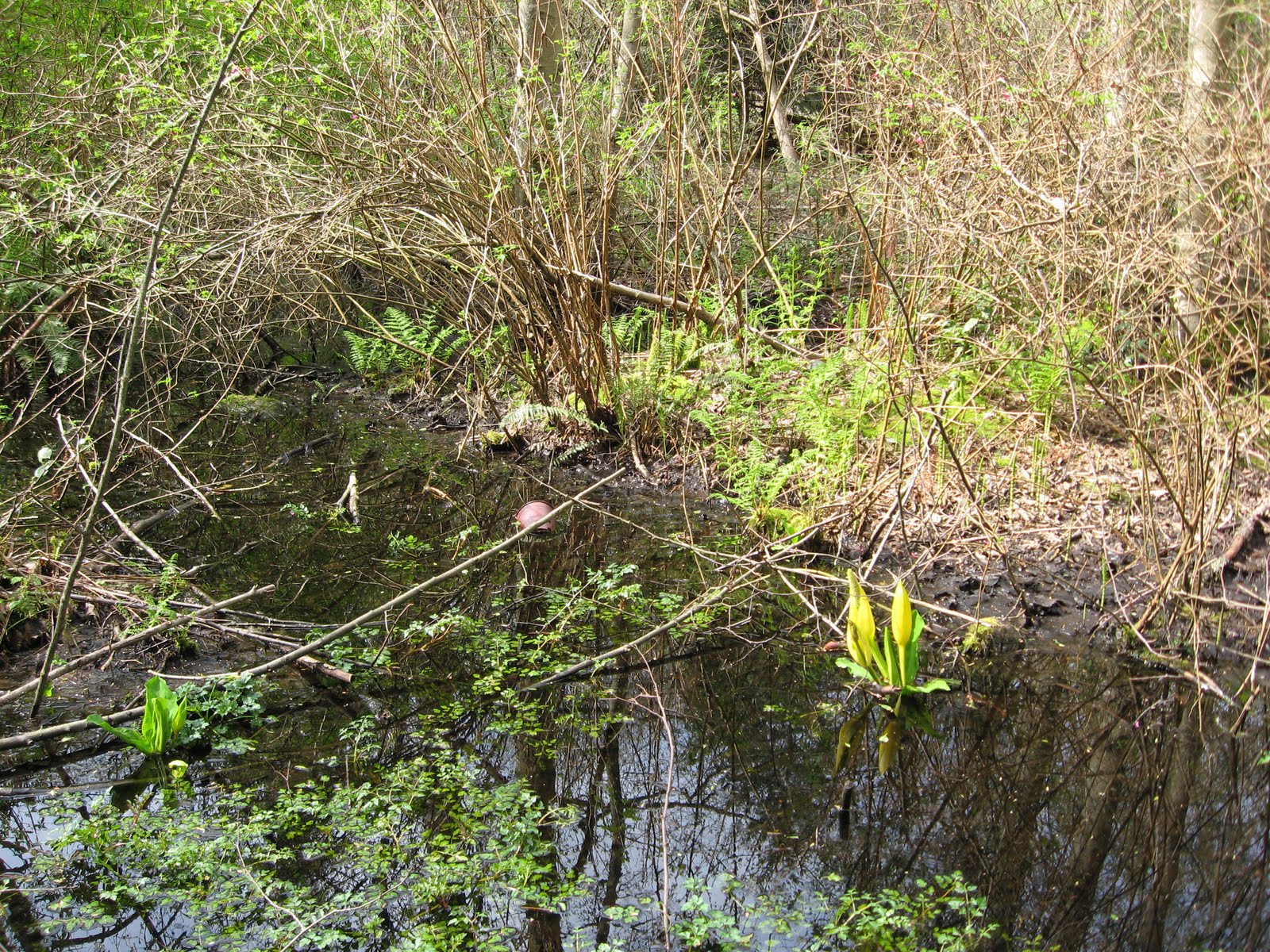
Skunk Cabbage in Paramount Park
ph cr - Janet Way


All over our area it is a beautiful indicator of spring, but also a key indicator species of a wetland area.  Wetlands are indicated officially by three factors,
according to the criteria of the Army Corps of Engineers;

• wetland plants, presence of water, and wetland soils.

Skunk Cabbage in Paramount Park Wetlands
4/10 ph cr - Janet Way
Wetlands are vital to our water quality and wildlife habitat. They retain huge amounts of groundwater and runoff in our watersheds. They are an important indicator of the health of our watersheds.
If you find a Skunk Cabbage in bloom, it a reason to be happy about something going right.

Paramount Park is a headwaters wetland area on Littles Creek, a tributary of Thornton Creek.

Tuesday, March 29, 2011

Of Paramount Importance Is On Temporary Hiatus

Apologies to our faithful followers.

Thornton Creek at TC Park #2
Due to technical difficulties, OPI is taking a break waiting for a technology repair. We will resume our coverage of local environmental, political and preservation news soon.


Thank you for your patience and please check back with us in a few days.


Sincerely,


Janet